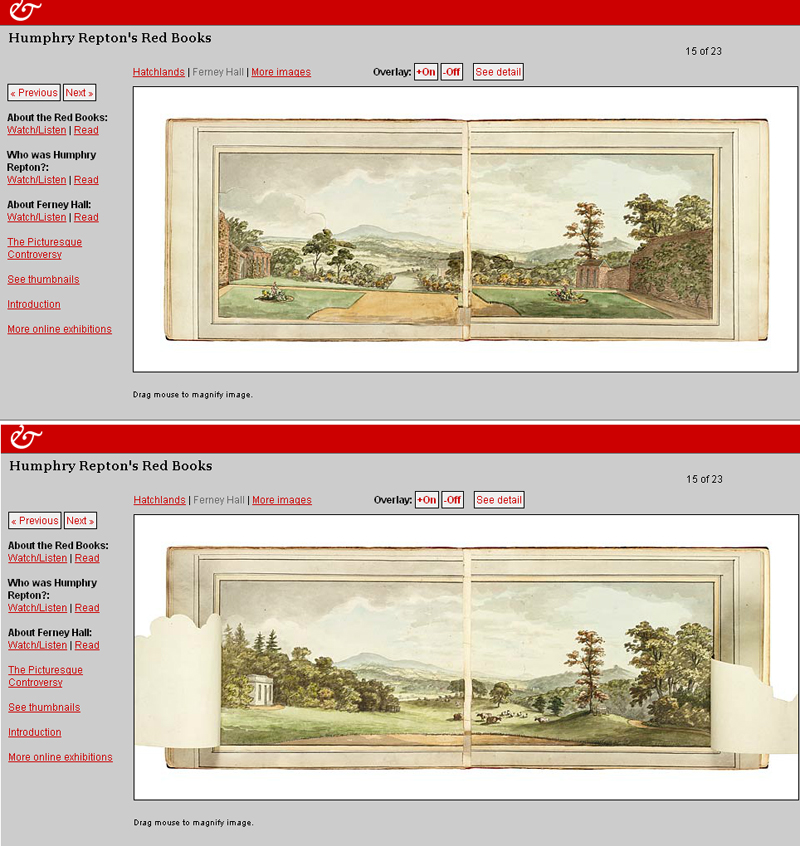
En una reciente presentación, alguien comentó que habíamos contado nuestro proyecto como si aun estuviéramos en el siglo XVIII. Esto es un elogio si miramos a las cuidadas presentaciones de Humphry Repton.
Recently, while presenting a project someone commented that we had done so as if we still were in the 18th Century. We take this as praise, if we look at Humpry Repton's exquisite presentations. (English text continues after Spanish text)
Humpry Repton (1752-1818) fue un paisajista inglés que trabajó para la alta sociedad inglesa, incluso llegó a realizar unos diseños para el Príncipe de Gales. Hoy es conocido por su arte de auto-promocionarse. Solía presentar a los clientes sus diseños bajo la forma de los denominados Red Books (libros rojos), cuyo nombre devienen del color rojo marruecos que usaba en la encuadernación. Ahora es posible admirar 2 de estos bellos libros en la exposición on-line Humphry Repton's Red Books, accesible a través de la página web de The Morgan Library & Museum (New York).
Pincha aquí para ver el Red Book 1: Hatchlands
Pincha aquí para ver el Red Book 2: Ferney Hall
Hemos disfrutado mucho esta exposición on-line y os recomendamos que la visitéis, hay multitud de información y de buenas aplicaciones. ¡No olvidéis de pulsar el botón +on/-off overlay!
Esta historia tiene varios vínculos con nuestras inquietudes: en primer lugar, parte de nuestro trabajo es resolver como hacer una presentación, especialmente en el caso de los concursos donde normalmente tenemos que compilar la complejidad de una propuesta: su concepto, implantación, representación, percepción, construcción, viabilidad, etc. en tan sólo 3 paneles que deben ser visto por un jurado entre un montón de paneles del resto de concursantes (ver las entradas etiquetadas como concursos/competitions). En segundo lugar porque también es un ejemplo de libro-objeto (ver las entradas etiquetadas como libro/book transversal) lo cual ha estado entre nuestros intereses últimamente: la expresión de secuencias espacio-temporales en el contenido de un libro, la interacción material entre libro y lector y el potencial de una lectura no lineal y adireccional siguiendo una narrativa física y subjetiva. Y por último, hemos llegado a esta referencia en el contexto de un nuevo concurso para un jardín, durante el proceso de investigación que acompaña a este tipo de trabajos; para así una vez más expresar nuestras nociones e ideas acerca del paisaje: su materia, el proceso de transformación que conlleva y sus tiempos.
Como valor añadido, hallar estos dos libros de Humpry Repton nos recuerda una vez más la importancia de ser creativo incluso en las circunstancias más adversas.
English text:
Humpry Repton (1752-1818) was an English landscape architect. He worked for the English high society, he even worked on some designs for the Prince of Wales. But nowadays he is well known for the art of self-promotion. He used to present his plans and ideas to his clients in the form of Red Books, thus named for their characteristic red morocco bindings. Now, we can look at 2 of those beautiful books at the on-line exhibition Humphry Repton's Red Books at The Morgan Library & Museum (New York) website:
Click here for Red Book 1: Hatchlands
Click here for Red Book 2: Ferney Hall
We have enjoyed visiting this on-line exhibition and we recommend checking it out. There is plenty of information and a hand full of great apps. Don't miss the +on/-off overlay button!
This story establishes several links with our interests: firstly, part of our job is how to prepare presentations, specially in the case of competitions where we have to compile the complexity of a project: its concepts, how it is set in its context, its representation, what it conveys, its construction, its viability, etc. in just 3 flat boards for panel of experts to look at among a pile of other competitors' boards (see the posts labelled under concursos/competitions). Secondly because it is an example of a book object (see all the entries labelled under libro/book transversal) which has been among our latest interests: how to convey space-time sequences in a book's content; the material interaction between book and reader, and the potential of non-linear, a-directional reading within a subjective physical narrative. And finally, we found this link doing some research for an upcoming competition for a garden in which once again we will be expressing our concerns about the matter of contemporary landscape, its transformation processes and transience.
Moreover, finding these two books by Humpry Repton reminds us yet again of the importance of being creative even under the most daunting circumstances.
Imagen/Image: 2 capturas de pantalla de la exposición on-line / 2 printscreens of the on-line exhibition http://www.themorgan.org
Las entradas etiquetadas como RECOMENDACIONES muestran proposiciones de exposiciones, lecturas,... que hemos disfrutado / Posts tagged RECOMMENDATIONS show suggested exhibitions, books, etc. that we have enjoyed
3 nov 2011
6 oct 2011
CASA SAN BARTOLOMÉ DE LA TORRE: MENCIÓN/MENTION XVIII PREMIO DE ARQUITECTURA HUELVA
Hoy, nuestra amiga Manuela nos ha regalado el Catálogo del XVIII Premio de Arquitectura del Colegio de Arquitectos de Huelva / Today, our friend Manuela has given us the Catalogue of the XVIII Architecture Prize of the Colegio de Arquitectos de Huelva
Este catálogo recoge las obras seleccionadas para el premio, entre las que se encuentra la vivienda unifamiliar aislada en San Bartolomé de la Torre (Huelva) proyectada por las arquitectas Tita Jiménez Guijarro, Cinta Román de la Torre y Manuela Peinado Palomero. Este proyecto ha recibido la mención especial del jurado. Lee la noticia completa pinchando aquí. ¡Enhorabuena a este equipo de arquitectas y también al resto de los seleccionados y premiados!
Esta casita, tal y como la presenta en el catálogo la hija de una de las arquitectas, es una sencilla obra de arquitectura cargada de sentimientos, y es más, de buen hacer. Su sencillez sin embargo concentra la compleja fenomenología de la casa y atiende especialmente a la relación de la casa con el paisaje. Y esto resulta grande a pesar de su delicada pequeñez. ¡Enhorabuena de nuevo!
Las entradas etiquetadas como CERCA-DE-KAUH muestran el trabajo de amigos y compañeros / Posts tagged CLOSE-TO-KAUH show work by friends and colleagues.
Este catálogo recoge las obras seleccionadas para el premio, entre las que se encuentra la vivienda unifamiliar aislada en San Bartolomé de la Torre (Huelva) proyectada por las arquitectas Tita Jiménez Guijarro, Cinta Román de la Torre y Manuela Peinado Palomero. Este proyecto ha recibido la mención especial del jurado. Lee la noticia completa pinchando aquí. ¡Enhorabuena a este equipo de arquitectas y también al resto de los seleccionados y premiados!
Esta casita, tal y como la presenta en el catálogo la hija de una de las arquitectas, es una sencilla obra de arquitectura cargada de sentimientos, y es más, de buen hacer. Su sencillez sin embargo concentra la compleja fenomenología de la casa y atiende especialmente a la relación de la casa con el paisaje. Y esto resulta grande a pesar de su delicada pequeñez. ¡Enhorabuena de nuevo!
The catalogue compiles the shorlisted works. Among them we can find the House in San Bartolomé de la Torre (Huelva ), a project by Tita Jiménez Guijarro, Cinta Román de la Torre and Manuela Peinado Palomero. This project received the honourable mention of the jury. You can read more about it here. Congratulations to these three architects and also to the rest of shorlisted and awarded entries!
This little house, as it is presented in the catalogue by the daughter of one of the architects, is a simple work of architecture full of sentiment, and moreover, wisdom. However its simplicity brings together the complex phenomenology of the house and takes into careful consideration the relationship of the house with the sourrounding landscape. And the result, despite its delicate smallness, is grand. Again, congratulations!
Las entradas etiquetadas como CERCA-DE-KAUH muestran el trabajo de amigos y compañeros / Posts tagged CLOSE-TO-KAUH show work by friends and colleagues.
5 oct 2011
20 VPO: COMIENZAN LAS OBRAS / GROUNDBREAKING OF 20 RENTAL SOCIAL HOUSING UNITS
Estamos trabajando: el pasado jueves 29 de septiembre comenzaron las obras del proyecto 20 viviendas VPO de alquiler en Conil de la Frontera / We are working: last Thursday September 29th the groundbreaking of the 20 Rental Social Housing Units project in Conil de la Frontera took place.
Imagen/image: 879 páginas y 94 planos / 879 pages and 94 drawing plans
20 sept 2011
El libro-objeto, el espacio-libro / Book-object, book-space
Presentamos el inicio de nuestra reflexión para la II Mesa Redonda Leer y Editar en la Era Digital, que se celebrará el próximo jueves 22 de septiembre.
Here are our first thoughts for the II Mesa Redonda Leer y Editar en la era digital (Reading and Editing in the Digital Age, II Round Table) that will take place next Thursday September 22.
“Materializar un libro es hacer realidad la secuencia espacio-temporal que su contenido expresa”
Ulisses Carrion “The New Art of Making Books”. Kontexts no. 6-7, 1975. Amsterdam
Editar un libro-objeto aún hoy es posible, porque siguen existiendo contenidos que lo requieren o porque mediante un libro-objeto ese mismo contenido adquiere su máxima expresión. En el caso del libro Transversal, que recopila las propuestas que se presentaron al concursoLa Transversal de la BIACS , organizado con motivo de la BIACS 3-YOUniverse (3ª edición de la Bienal de Arte Contemporáneo de Sevilla), esta opción editorial se hizo más acuciante por la necesidad de trasladar al “espacio-libro” el recorrido urbano que en su conjunto establecieron las cinco intervenciones expuestas durante la celebración de la BIACS 3 en cinco “espacios de la ciudad” (las fachadas del ICAS y de la Facultad de Bellas Artes en calle Laraña, y los patios del Colegio de Arquitectos, de EMASESA y de la Facultad de Bellas Artes en calle Gonzalo Bilbao). De ahí que se entienda este libro como otra intervención “transversal” más, esta vez en forma de edición, de esta manera el mensaje final que se propone al lector es el libro en sí, el libro en su totalidad. Un volumen autónomo en el espacio y en el tiempo que indaga en las posibilidades materiales de la edición impresa como variable diferenciadora del papel frente al distinto campo de la publicación digital.
In this example of a book-object, the subject matter, a collection of interventions in architectural urban spaces, allows the book to break free from its planar character. Written words and images are balanced while thought and action dialogue, so that it makes sense to tackle the edition of a book-object as a space-time sequence. We could say that even though book-objects have deep roots in the history of print, presently they still hold their distance from the traditional editorial model and penetrate a field that is complementary to digital publications.
A book in its traditional format (at the heart of all debates these days) is, in part, an accidental container of texts, images, etc. By contrast, stakes can still be put in for book-objects by understanding that a book-object is not an accidental container; it is content in itself. Perhaps this is why it will still have a role to play given the final advent of digitalization, as another link in the value chain of the BOOK in all its contemporary forms.
Lo puedes leer también aqui / You can also read this here.
Here are our first thoughts for the II Mesa Redonda Leer y Editar en la era digital (Reading and Editing in the Digital Age, II Round Table) that will take place next Thursday September 22.
“Materializar un libro es hacer realidad la secuencia espacio-temporal que su contenido expresa”
Ulisses Carrion “The New Art of Making Books”. Kontexts no. 6-7, 1975. Amsterdam
Editar un libro-objeto aún hoy es posible, porque siguen existiendo contenidos que lo requieren o porque mediante un libro-objeto ese mismo contenido adquiere su máxima expresión. En el caso del libro Transversal, que recopila las propuestas que se presentaron al concurso
El contenido, en este caso de libro-objeto, al ser muestra de intervenciones en espacios urbano-arquitectónicos, permite liberar al libro de su condición plana. La palabra escrita y las imágenes se equilibran, la reflexión y la muestra dialogan, con lo que adquiere sentido afrontar la edición del libro-objeto como una secuencia espacio-temporal. Podríamos decir que, aún estando profundamente enraizado el libro-objeto en la historia y génesis del libro, aún hoy se distancia del modelo editorial tradicional y se adentra en un campo complementario al de la publicación digital.
Apostar por el libro-objeto en este momento viene de entender que el libro en su formato tradicional (tan en debate), es, en parte, un contenedor accidental de texto, imágenes… Mientras que el libro-objeto no es un contenedor accidental, es contenido en sí mismo. Quizás por ello está llamado a tener un papel en el advenimiento definitivo de la digitalización de contenidos, un eslabón más en la cadena de valor del LIBRO entendido ya esté en todas sus acepciones contemporáneas.
Ulisses Carrion “The New Art of Making Books”. Kontexts no. 6-7, 1975. Amsterdam
To edit a book-object nowadays is still possible because, on the one hand, contents that require such an option still exist and, on the other, by means of a book-object those contents reach their maximum expression. This is the case of the book Transversal, a compilation of the proposals that were submitted to the competition known as The Transversal of the BIACS, organised within the Biennial of Contemporary Art of Seville, BIACS3-Youniverse. This editorial option became pressing because of the need to put into “book-space” the urban route that the five winning interventions established in five “spaces of the city” (the façades of the ICAS and of the Faculty of Fine Arts on calle Laraña, and the courtyards of the Colegio de Arquitectos, of the headquarters of EMASESA and of the Faculty of Fine Arts on calle Gonzalo Bilbao). It is our understanding that this book is yet another “transversal” intervention, this time in edition form, so that the final message to readers is the book in itself, the book in its totality. The book becomes an autonomous volume in space and time, inquiring into the material possibilities of printed edition as the differentiating variable of paper in contrast with the very different field of digital publications.
A book in its traditional format (at the heart of all debates these days) is, in part, an accidental container of texts, images, etc. By contrast, stakes can still be put in for book-objects by understanding that a book-object is not an accidental container; it is content in itself. Perhaps this is why it will still have a role to play given the final advent of digitalization, as another link in the value chain of the BOOK in all its contemporary forms.
Lo puedes leer también aqui / You can also read this here.
Fotografía de CienxCien Producción Fotográfica. Photograph by CienxCien Producción Fotográfica.
Cortesía de Buenos días, proyectos para el entorno. Courtesy of Buenos días, proyectos para el entorno.
9 sept 2011
II Mesa Redonda Leer y Editar en la era digital
El próximo 22 de septiembre participaremos en la II Mesa Redonda Leer y Editar en la era digital, una actividad organizada por la Universitat Oberta de Catalunya (UOC)/
On September 22 we will take part in the II Mesa Redonda Leer y Editar en la era digital (Reading and Editing in the Digital Age, II Round Table), organised by Universitat Oberta de Catalunya (UOC).
Lugar, hora / place, date: Sede de la UOC en Sevilla Sala Helvetia (Paseo de Cristobal Colón, 26). 19:00 h
+ Info: Blog Actividades en la Red Territorial
On September 22 we will take part in the II Mesa Redonda Leer y Editar en la era digital (Reading and Editing in the Digital Age, II Round Table), organised by Universitat Oberta de Catalunya (UOC).
Lugar, hora / place, date: Sede de la UOC en Sevilla Sala Helvetia (Paseo de Cristobal Colón, 26). 19:00 h
+ Info: Blog Actividades en la Red Territorial
14 jun 2011
QUADERNS 1/4 #261, 2011
Hoy hemos tenido el placer de recibir el primer número de la nueva etapa de la revista Quaderns/
Today we’ve had the pleasure of receiving the first issue of Quaderns’ new period
La edición de esta nueva etapa está a cargo de José Zabala (Director), junto con Mario Ballesteros y Guillermo López. Este primer número refleja la cuidada edición y el buen trabajo elaborado por el equipo de redacción.
The magazine’s new phase is headed by José Zabala, with Mario Ballesteros and Guillermo López. Their first issue shows how carefully edited it is as well the good work carried out by the entire team. The magazine has the format of a notebook, as they describe it themselves in its opening pages, in which they also explain the structure that the issues will follow: Visual Essay, Agenda, 1x3, Archive, 3x1, Guest and Observatory. This series of interesting parts are complementary to one another and become the tools with which to look into the different possibilities that editing using a paper format allows to enable the spreading of architectural knowledge. As a complement to the paper edition, throughout the different sections a series of codes appear linked to Quaderns’ blog (a digital appendix to each printed issue of Quaderns, but also a complimentary, expanded editorial platform), where the information of the printed issue is expanded. All in all, the importance of this kind of institutional magazines as tools capable of encouraging and generating architectural culture and research is underlined.In our opinion the contents of this issue are carefully balanced, and we appreciate its materiality. As a whole, it’s a joy to read.
Today we’ve had the pleasure of receiving the first issue of Quaderns’ new period
La edición de esta nueva etapa está a cargo de José Zabala (Director), junto con Mario Ballesteros y Guillermo López. Este primer número refleja la cuidada edición y el buen trabajo elaborado por el equipo de redacción.
La revista tiene un formato de cuaderno, tal y como anotan en la presentación en la que desgranan la estructura que seguirán los números: Ensayo visual, Agenda, 1 sobre 3, Archivo, 3 sobre 1, Invitado y Observatorio. Una serie de interesantes secciones que se complementan entre si, y que indagan en el hecho de las posibilidades de la edición en papel de la difusión de conocimiento arquitectónico. Como complemento a esta edición en papel, en las distintas secciones aparecen códigos vinculados con el blog Quaderns (un apéndice digital para cada número impreso de Quaderns, pero también una plataforma editorial complementaria) donde se amplia la información de la edición impresa. Con todo ello, se subraya la importancia de la revista colegial como herramienta con capacidad para el fomento y generación de la cultura e investigación arquitectónica.Encontramos un sutil balance entre los contenidos de este número, y un apreciable gusto en su materialidad. En su conjunto, nos hace disfrutar como lectores.
En estos tiempos difíciles en los que en otros casos las revistas colegiales pasan por momentos críticos dado el negativo impacto que están produciendo sobre su continuidad e incluso supervivencia las políticas económicas y culturales de los colegios, valoramos enormemente el esfuerzo por el trabajo realizado. Un trabajo en el que se ha sabido reconocer el potencial de los recursos personales, económicos y técnicos (materiales y virtuales) disponibles para generar un producto de altísima calidad material e intelectual. Un trabajo que, en sí y extrapolándolo al campo profesional general, desvela una vez más nuestro papel crucial como agentes creativos capaces de generar los mejores lugares —en el sentido más amplio de la palabra, considerando por lo tanto las revistas como “lugares” de debate, exposición y reflexión— para el desarrollo de nuestras sociedades.
Gracias. Os deseamos una próspera etapa.
The magazine’s new phase is headed by José Zabala, with Mario Ballesteros and Guillermo López. Their first issue shows how carefully edited it is as well the good work carried out by the entire team. The magazine has the format of a notebook, as they describe it themselves in its opening pages, in which they also explain the structure that the issues will follow: Visual Essay, Agenda, 1x3, Archive, 3x1, Guest and Observatory. This series of interesting parts are complementary to one another and become the tools with which to look into the different possibilities that editing using a paper format allows to enable the spreading of architectural knowledge. As a complement to the paper edition, throughout the different sections a series of codes appear linked to Quaderns’ blog (a digital appendix to each printed issue of Quaderns, but also a complimentary, expanded editorial platform), where the information of the printed issue is expanded. All in all, the importance of this kind of institutional magazines as tools capable of encouraging and generating architectural culture and research is underlined.
During these difficult times in which, in other cases, the situation of these magazines is critical due to the negative impact that the economic and cultural policies of their mother institutions is having on their continuity and even their survival, we greatly appreciate the enormous effort that this work entails. The work carried out shows the editors’ awareness in recognizing the potential of the personal, economic and technical (both material and virtual) resources available in order to generate a product of high material and intellectual quality. A way of working that, in itself and applying it to the general architectural field, reveals once again the key role architects have as creative agents capable of generating the best places –in the broadest sense of the term, thus considering magazines “places” to debate, show and think- for our societies’ development.
Thank you. We wish you the best in this new era.
Web de José Zabala / José Zabala's Web: http://www.josezabala.com/
Quaderns es una publicación del Col.legi D'Arquitectes de Catalunya / Quaderns is published by Col.legi D'Arquitectes de Catalunya
3 may 2011
LAUS 2011, LIBRO TRANSVERSAL BOOK: 4 BRONCES 4 / 4 BRONZES 4
DISEÑO GRÁFICO / GRAPHIC DESIGN:
Portada de libro / Book cover
Libro completo / Complete book
Catálogo / Catalogue
ADMINISTRACIONES PÚBLICAS / PUBLIC ADMINISTRATION:
Editorial
+info:
LAUS 2011 Bronces / Bronzes
Buenos días,
CICUS
europapress
Diario de Sevilla
Video cortesía de Buenos días, / Video courtesy of Buenos días,
Transversal from buenos dias on Vimeo.
Portada de libro / Book cover
Libro completo / Complete book
Catálogo / Catalogue
ADMINISTRACIONES PÚBLICAS / PUBLIC ADMINISTRATION:
Editorial
+info:
LAUS 2011 Bronces / Bronzes
Buenos días,
CICUS
europapress
Diario de Sevilla
Video cortesía de Buenos días, / Video courtesy of Buenos días,
Transversal from buenos dias on Vimeo.
Suscribirse a:
Entradas (Atom)


