Mostrando entradas con la etiqueta ALCAICERÍA. Mostrar todas las entradas

13 abr 2015

LA CULTURA Y LA CIUDAD - GRANADA

El que no ha visto Graná, no ha visto ná 
Esta semana participamos en el congreso LA CULTURA Y LA CIUDAD. Imagen y representaciones de lo urbano, ciudades históricas y eventos culturales. Como parte de nuestra línea de trabajo "investigación independiente" presentaremos la comunicación Alcaicería. Realidad y ficción. Compartimos un avance de la presentación: un gif animado basado en una escena de la película ¿Qué he hecho yo para merecer esto! (Pedro Almodóvar, 1984), que recoge el breve pero revelador diálogo que transcurre en el madrileño Bar Alhambra.

This week we will participate in the Conference LA CULTURA Y LA CIUDAD. Imagen y representaciones de lo urbano, ciudades históricas y eventos culturales. As part of our "independient research" line of work, we will be presenting the communication The Alcaicería of Granada. Reality and Fiction. This is an advance of the presentation: an animated gif based on a caption of the movie What I have done to deserve this? (¿Qué he hecho yo para merecer esto! Pedro Almodóvar, 1984), that includes the short but eye-opening dialogue that takes place in the Bar Alhambra from Madrid.

+ info:
- LA CULTURA Y LA CIUDAD

Imagen/image:
Gif [JASM, 2015]. Taberna Alhambra, Madrid. c. 1920s . Pedro Almodóvar (dir.) ¿Qué he hecho yo para merecer esto!, España, 1984, minuto 34-35

17 dic 2014

La Alcaicería de Granada (3)

Retomamos la mirada sobre la Alcaicería de Granada, esta vez proponemos un retrato en claves de realidad y ficción
Once again we approach the subject of the Alcaicería of Granada. This time we portray it under the subject of reality and fiction

El espacio real/ The real space
La comunicación Alcaicería de Granada. Realidad y ficción ha sido seleccionada, en convocatoria abierta, para ser presentada en el Congreso internacional “La cultura y la ciudad. Imagen y representaciones de lo urbano. Ciudades históricas y eventos culturales” (Granada, 15-17 abril 2015)

The communication The Alcaicería of Granada. Reality and Fiction has been selected, via an open call, to be presented in the International Congress “La cultura y la ciudad. Imagen y representaciones de lo urbano. Ciudades históricas y eventos culturales” (Granada, 15-17 April 2015)

Resumen:
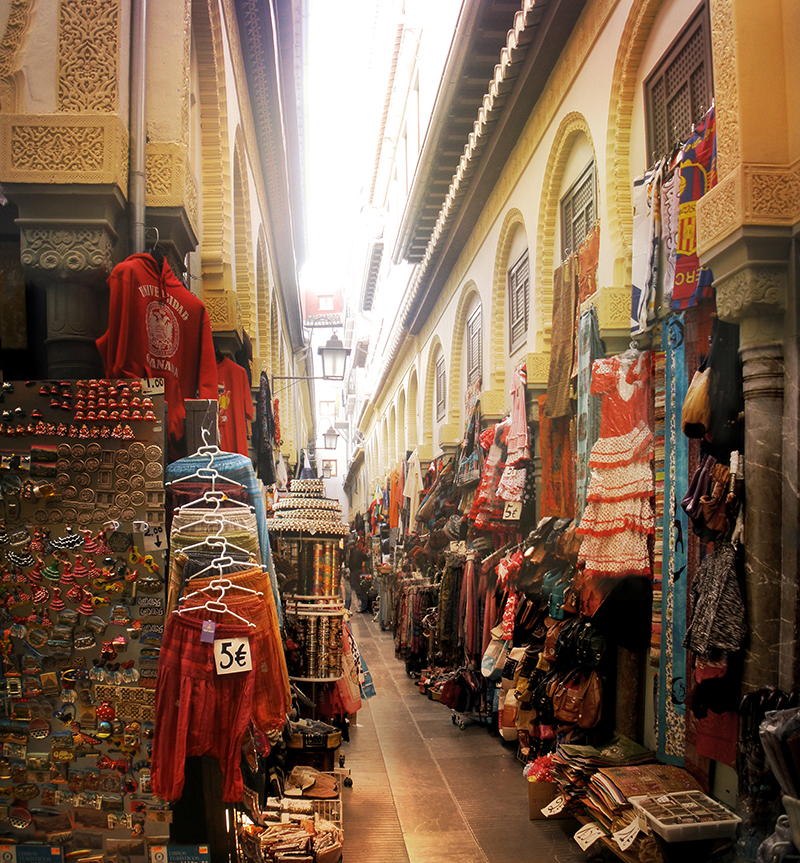
La Alcaicería de Granada se podría caracterizar como un paisaje post-turístico (URRY, 1990). Este enclave histórico, en origen recinto cerrado y actualmente parte de la trama urbana, ha estado dedicado, ininterrupidamente y al menos durante los últimos cinco siglos, al comercio. Hoy su atmósfera mimética decimonónica recientemente remozada, llena de souvenirs genéricos y pocos productos artesanales locales, es un foco comercial, turístico y cultural, a la vez que tiene cierta condición de monumento marginal.
La comunicación parte de un estudio histórico. Rastrea el origen de las alcaicerías para presentarlas como una tipología arquitectónica que progresivamente decantó, como último ejemplo en nuestro entorno, en un lugar específico en Granada. Enfocar el estudio en la crónica de la Alcaicería de Granada nos muestra cómo el lugar ha evolucionado desde sucesivos espacios comerciales al espacio híbrido turístico-comercial que es hoy. El último hito de esta crónica liga el espacio real con un espacio recreado al hilo de la celebración del Primer Milenio del Reino de Granada con el evento "Alcaicería del milenio" (Jaén y Almería 2011- Granada 2013), el cual devolvió a la palabra su carácter genérico, esta vez en claves contemporáneas de ficción y mercadillo itinerante de cartón piedra. Esto nos coloca en el debate contemporáneo sobre cómo se ha construido y se construye la imagen de la ciudad, incluyendo la impronta de la capa digital.
Analizar el detalle de la Alcaicería replicada y compararla con el devenir de la Alcaicería real nos ayuda a enunciar claves del contexto cultural y contemporáneo de Granada, una ciudad histórica con un importante impacto de la actividad turística y una larga y fuerte tradición en la construcción de su imagen —el "mito de Granada" (CALATRAVA, 2002).
Comercio, turismo, evento y patrimonio se entrelazan para escenificar una estampa que mezcla, en dosis diferenciadas, realidad y ficción.

El espacio recreado / The recreated space
Abstract:
Granada's Alcaiceria can be considered as a post-touristic landscape (URRY, 1990). This historic landmark, originally a closed quarter but currently part of the urban fabric, has been dedicated to commerce uninterruptedly for, at least, the last five centuries. Nowadays, its recently restored and mimetic nineteenth-century atmosphere full of generic souvenirs and just a few local handmade products is a commercial, touristic and cultural hotspot. It is also a historic monument, although it sits on the sidelines.
This communication begins with a historic study. It tracks the origins of alcaicerias to show that they were an architectural typology that eventually evolved into a specific space. Granada's is the last example that stands of such a place in our context. By focusing the study on the chronicle of Granada's Alcaiceria we are shown how the place has evolved as a succession of commercial spaces to become the hybrid touristic-commercial space that is has become today. The last chapter of this story brings together this real space with a recreated space. Following the celebration of the First Millennial of the Kingdom of Granada with an event called "Alcaiceria of the Millennial" (Jaen and Almeria 2011 - Granada 2013), the word was given back its generic meaning, but this time with a contemporary fictional twist in the form of an itinerant paper mache market. This situates the issue within the context of the contemporary debate about how the image of our cities has been and still is created, including the imprint of the digital layer.

To analyze the details of the replicated Alcaiceria and to compare it with the evolution of the real Alcaiceria helps us outline key concepts regarding Granada's contemporary cultural context; a historic city heavily impacted by touristic activity as well as a longstanding and entrenched tradition in the recreation of its own image—the "myth of Granada (CALATRAVA, 2002).
Commerce, tourism, events and heritage intertwine to paint a picture that mixes, in differentiated doses, reality and fiction.

Previamente, sobre la Alcaicería / Previously on the Alcaicería: 
- Artículo / Article: The Alcaicería of Granada (Spain): From a silk trade center to a post-touristic shopping-scape. Lusofona Journal of Architecture and Education
- Entradas en este blog / Post on this blog: http://kauharquitectos.blogspot.com.es/search/label/ALCAICERÍA

+ info: “La cultura y la ciudad. Imagen y representaciones de lo urbano. Ciudades históricas y eventos culturales”
Información general / general info: https://laculturaylaciudad.wordpress.com/bases/
  Proyecto de Investigación Ciudades históricas y eventos culturales (HAR2012-31133), Universidad de Granada
  Grupo de Investigación Arquitectura y Cultura Contemporánea (HUM-813), Universidad de Granada
  Departamento de Construcciones Arquitectónicas, Universidad de Granada
  Escuela de la Alhambra (Patronato de la Alhambra y Generalife)


Fotos / Photos:
1. Alcaicería de Granada. 12/2014. JASM
2. Alcaicería del Milenio / Alcaicería of the Millennial. Granada 2013. Fuente/source: Blog voluntarios del Milenio "Fotos de Santi" 13/10/2013 http://voluntariosmilenioreinodegranada.blogspot.com.es/2013/10/alcaiceria-del-milenio-del-reino-de_13.html

Editado y traducido por / Edited and translated by: conVince: http://translateandconvince.wordpress.com/

5 sept 2013

The Alcaicería of Granada (2)

Compartimos las diapositivas de la comunicación / We share the slide presentation of the communication: "The Alcaicería of Granada (Spain). From a silk trade center to a post-touristic shopping-scape" [English text continues after Spanish text]

Esta comunicación fue presentada el pasado mes de mayo en Lisboa en la Conferencia Internacional ShoppingScapes´13, Universidade Lusófona de Humanidades e Tecnologias.
Resumen: La Alcaicería de Granada es un lugar histórico que se podría definir, desde una óptica contemporánea, como un paisaje comercial post-turístico. Durante el periodo árabe medieval, el término al-qaysāriyya describía tanto la institución comercial que regía el comercio de la seda como la tipología arquitectónica creada para este fin. En Al-Andalus, la tipología era un grupo de tiendas localizado en el centro de las principales ciudades. Tras la Reconquista, estos recintos se mantuvieron e incluso se construyeron espacios comerciales llamados alcaicerías en América y Filipinas. La decadencia del comercio de la seda provocó la desaparición de estos espacios excepto la de Granada. La crónica de la Alcaicería de Granada comienza con un documento de compraventa (1460), continúa con la reconstrucción en estilo Alhambresco (1843) y su conversión a mercado temático de artesanía (1940) hasta su reciente restauración (2002). Hoy, la atmósfera mimética llena de souvenirs y algunos pocos productos artesanales locales, es un escenario comercial urbano que mezcla realidad y ficción para los turistas.
Palabras clave: Alcaicería. Granada. Estructuras comerciales. Post-turismo. Comercio de la seda
Esta comunicación fue presentada en inglés, de ahí que todos los títulos y comentarios en las diapositivas se encuentren en este idioma. La versión española será accesible próximamente. Para leer el post anterior acerca de este tema: haz click aquí 
Lo que queda de la seda / The remains of the silk
English Text

We presented this communication in May in Lisbon during the International Conference ShoppingScapes´13, Universidade Lusófona de Humanidades e Tecnologias.
Abstract: The Alcaicería of Granada is a contemporary post-touristic shopping-scape with deeps roots in history. In the Medieval Arab world, the term al-qaysāriyya described a commercial institution for the silk trade as well as an architectural typology. In Al-Andalus, the typology was a cluster of shops located in the center of the main cities. After the Reconquest, these structures were maintained and alcaicerías were even built, as commercial spaces, in America and the Philippines. The decline of the silk trade provoked their disappearance, with the exception of Granada's. The chronicle of the Alcaicería of Granada begins with a "transaction document" (1460), continues with its reconstruction in Alhambresque style (1843) and its conversion into a theme market for handcrafts (1940), to its recent restoration (2002). Today, the mimetic atmosphere full of souvenirs, among just a few local crafts, is a commercial urban scenario that mixes reality and fiction for tourists.
Keywords: Alcaicería. Granada. Shopping Structures. Post-tourism. Silk Trade
The communication was originally presented in English. If you want to read the previous post about this subject: click here


21 may 2013

The Alcaicería of Granada & ShoppingScapes'13

A post-touristic shopping-scape in a mimetic Alhambresque atmosphere
La semana que viene estaremos en Lisboa presentando la comunicación: "The Alcaicería of Granada (Spain). From a silk trade center to a post-touristic shopping-scape" en la Conferencia Internacional ShoppingScapes´13, Universidade Lusófona de Humanidades e Tecnologias.

Next week, we will be in Lisbon presenting the communication: "The Alcaicería of Granada (Spain). From a silk trade center to a post-touristic shopping-scape" during the International Conference ShoppingScapes´13, Universidade Lusófona de Humanidades e Tecnologias.

The Alcaicería of Granada (Spain). From a silk trade center to a post-touristic shopping-scape
Abstract: The Alcaicería of Granada is a contemporary post-touristic shopping-scape with deep roots in history. In the Medieval Arab world, the term al-qaysāriyya described a commercial institution for the silk trade as well as an architectonic typology. In Al-Andalus, the typology was a cluster of shops located in the center of the main cities. After the Reconquest, these structures were maintained and alcaicerías were even built, as commercial spaces, in America and the Philippines. The decline of the silk trade provoked their disappearance, with the exception of Granada's. The chronicle of the Alcaicería of Granada begins with a "transaction document" (1460), continues with its reconstruction in Alhambresque style (1843) and its conversion into a theme market for handcrafts (1940), to its recent restoration (2002). Today, the mimetic atmosphere full of souvenirs, among just a few local crafts, is a commercial urban scenario that mixes reality and fiction for tourists. 
 Keywords: Alcaicería. Granada. Shopping Structures. Post-tourism. Silk Trade
Postcards from the Alcaicería. Left: 1905; right: circa 1970's
Esta comunicación fue seleccionada a través de Convocatoria Abierta / This communication was selected via an Open Call for Communications.

About ShoppingScapes'13:
The designation of "ShoppingScapes" tries to focus in a word the meeting of ideas related to the presence and meaning of commercial superstructures that have been spreading throughout the territory, transforming and (re)building the landscape, as well as affecting the development of cities in general.
Similarly, the description also applies to a variant of the traditional shopping mall, which generally punctuates the suburban area, appearing as authentic commercial retail hubs, assuming their strange and contradictory condition of non-cities, emptying the traditional city centre of characteristic activity with its displacement. [Excerpt from the website]


International Conference ShoppingScapes´13 (27 to 30 May), Lisboa, Portugal. Universidade Lusófona de Humanidades e Tecnologias. Institut Français du Portugal.

Website: http://shoppingscapes.ulusofona.pt/