Mostrando entradas con la etiqueta HISTORIAS/STORIES. Mostrar todas las entradas

11 jun 2015

GAILLARDIAS

Los jardines cuentan pequeñas historias afectivas, aquí un ejemplo / Gardens tell us small stories full of affectivity, here is an example
Conil - 242 km - Granada
Las dos fotos que ilustran esta entrada son recientes, ambas retratan flores de la misma especie: Gaillardias sp. Una se encuentra a 242 kilómetros en línea recta de la otra. Las hemos puesto juntas porque, además de ser la misma flor, una procede de la otra. Tía Cati nos dio semillas hace un año  —a ella, a su vez, se las había regalado el hijo de una amiga; nosotros la guardamos hasta que llegó el tiempo de sembrarlas, y en este tiempo del año las estamos disfrutando, tía Cati en Conil y nosotros en Granada.
El jardín que cultivamos está lleno de estas pequeñas historias afectivas, algunas antiguas y otras nuevas, son hilos invisibles que unen plantas con muchas geografías, familiares y amigos, recordar estas relaciones hacen al jardín aún más bello. Cuando visites un jardín pregúntate cómo llegó ahí la planta que estas viendo, en la mayoría de los casos la historia que encierra te sorprenderá y casi siempre te devolverá una sonrisa.
Gaillardias, Vista Alegre: border in process / arriate en proceso

English Text
The two pictures that accompany this post are recent. They both show flowers of the same species: Gallardias sp. One is 242 kilometers away from the other following a strait line. We set them side by side because, not only are they the same flower, but one comes from the other. Aunt Cati gave us seeds a year ago—in turn, she had gotten hers from a friend's son. We saved ours until it was time to plant them, and now is the time of year we can enjoy them, aunt Cati in Conil, and us, here in Granada.
The garden we cultivate is full of small, affective stories like this one. Some are old and others are new. They make up an invisible network that joins plants with other geographies, our families and friends, and these relationships are what make a garden even more beautiful. Whenever you visit a garden ask yourself how the plant you are looking at got there. You would be surprised to know some of the stories behind them and they will surely make you smile.

una línea invisible / an invisible line
Editado y traducido por / Edited and translated by: conVince: http://translateandconvince.wordpress.com/

27 mar 2013

STIPA CHINOISERIE

El agro-chinesco y el 'cesto español'  / The agro-chinoise & 'the spanish basket'
148 años separan estas dos arquitecturas, ¿qué tienen en común? / 148 years separate these two architectures, what do they have in common? (English text continues after Spanish text)

A pesar de este abanico temporal estas dos arquitecturas tienen mucho en común: ambas fotos ilustran ejemplos de arquitectura efímera erigidos con motivo de un evento, uno tiene un aire Chinoiserie y el otro está en China; y quizás lo más singular es que ambos usan materiales muy similares: esparto (stipa tenacissima) y mimbre.

El pabellón de esparto de Almeria fue una arquitectura efímera construida con motivo de la visita de la Reina Isabel II en 1862. Su construcción fue promovida por el gremio del esparto, uno de los principales negocio locales de la época. Tuvo un uso más allá de lo meramente decorativo u ostentoso, la reina arribó en barco a la ciudad y descansó en el pabellón antes de realizar la visita por la ciudad. Esta fotografía fue realizada por Charles Clifford, quien acompañaba al séquito real. Se considera la primera fotografía de Almeria junto a otra del mismo autor que muestra una panorámica de la ciudad desde el Barrio de la Chana.

El pabellón de España en la Expo de Shanghai de 2010 (China) fue diseñado por el estudio de arquitectura EMBT (Enric Miralles - Benedetta Tagliabue). Según su web: "El edificio, con un área de 8000 metros, se inspira en las cestas de mimbre. Sus fachadas se cubrirán de este material que está presente en las artesanías españolas y chinas".

Un deseo: si nuestro proyecto del parque de la Hoya de Almería sale adelante, nos gustaría investigar el uso del esparto, vivo para las plantaciones y manufacturado para las zonas de sombra.


Esparto: vivo y manufacturado / living plant & handcrafted
ENGLISH TEXT

Despite the time that spans between these two architectures, both examples have a lot in common: they illustrate examples of ephemeral architectures built for an event; one has a certain Chinoiserie touch,the other one was in China, and above all both were built with similar materials: esparto grass (stipa tenacissima) and wicker.

The Esparto Pavilion (Amería) was a temporary structure, built on occasion of the visit of the Spanish Queen Isabel II in 1862. It was promoted by the guild of the esparto craftmen —during those days, one of the main local business. The pavilion wasn't merely ornamental and showy, the Queen used it to rest after she arrived by boat at the city port. The picture was taken by Charles Clifford, who accompanied the royal entourage. It is considered the first picture of Almería along with another one taken by the same author showing a  panoramic view of the city from La Chana neighborhood. 

The Spanish Pavilion for Expo Shanghai 2010 (China) was designed by EMBT (Enric Miralles - Benedetta Tagliabue). According to the website of the architects: "the building, with an area of 8000 meters, is inspired on wicker baskets. Its façades will be covered by this material which is present both in Spanish and Chinese traditional arts & crafts".

We would like to express a wish: if our project for the Park of la Hoya (Almería) restarts, we would like to investigate the use of this material, esparto grass, in its live form for planting schemes and handcrafted to create shaded areas.

Fuentes / sources:
-Isabel II 150 años de una visita real. Reportaje de Alberto F. Cerdera. Nova Ciencia 84 pp. 20-23 (click aquí) / Novapolis , 20/10/2102 (click aquí)
-Foto: Almería. Pabellón de Esparto. Recurso de investigación de la Alhambra (click aquí)
-Spanish Pavilion for Expo Shanghai 2010 Website Miralles Tagliabue (click aquí)
-El 'cesto español' en Shanghai. Reportaje EL PAIS, Maite Nieto (28/04/2010) (click aquí)
-Acerca del esparto (Stippa): www.floradealmeria.es (trabajo de Luis Posadas Fernández)

Créditos imágenes:
-Pabellón de Esparto, fotografía de Charles Clifford (1862, octubre). Obtenida en Isabel II 150 años de una visita real. de Alberto F. Cerdera (click aquí)
-Spanish Pavilion for Expo Shanghai 2010 obtenida en Website Miralles Tagliabue (click aquí)
-Tríptico, de izquierda a derecha: 1. Fotografía de www.floradealmeria.es (© Luis Posadas Fernández); 2. Descargada de significado de Pleita en fítitú; 3. Fotografía sombreros al sol de Wosu

Las entradas llamadas CORTOS/SHORTS muestran brevemente episodios de arquitectura  / Posts tagged CORTOS/SHORTS show briefly episodes of architecture

3 nov 2011

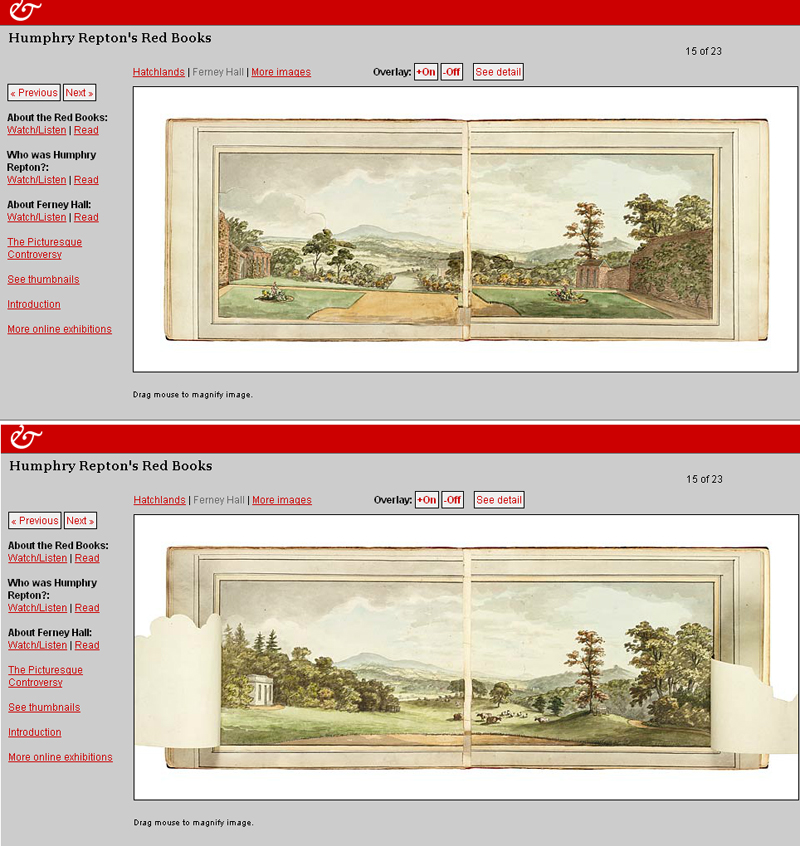
Humpry Repton's Red Books

En una reciente presentación, alguien comentó que habíamos contado nuestro proyecto como si aun estuviéramos en el siglo XVIII. Esto es un elogio si miramos a las cuidadas presentaciones de Humphry Repton.
Recently, while presenting a project someone commented that we had done so as if we still were in the 18th Century. We take this as praise, if we look at Humpry Repton's exquisite presentations. (English text continues after Spanish text)

Humpry Repton (1752-1818) fue un paisajista inglés que trabajó para la alta sociedad inglesa, incluso llegó a realizar unos diseños para el Príncipe de Gales. Hoy es conocido por su arte de auto-promocionarse. Solía presentar a los clientes sus diseños bajo la forma de los denominados Red Books (libros rojos), cuyo nombre devienen del color rojo marruecos que usaba en la encuadernación. Ahora es posible admirar 2 de estos bellos libros en la exposición on-line Humphry Repton's Red Books, accesible a través de la página web de The Morgan Library &  Museum (New York).

Pincha aquí para ver el Red Book 1: Hatchlands
Pincha aquí para ver el Red Book 2: Ferney Hall

Hemos disfrutado mucho esta exposición on-line y os recomendamos que la visitéis, hay multitud de información y de buenas aplicaciones. ¡No olvidéis de pulsar el botón +on/-off overlay!

Esta historia tiene varios vínculos con nuestras inquietudes: en primer lugar, parte de nuestro trabajo es resolver como hacer una presentación, especialmente en el caso de los concursos donde normalmente tenemos que compilar la complejidad de una propuesta: su concepto, implantación, representación, percepción, construcción, viabilidad, etc. en tan sólo 3 paneles que deben ser visto por un jurado entre un montón de paneles del resto de concursantes (ver las entradas etiquetadas como concursos/competitions). En segundo lugar porque también es un ejemplo de libro-objeto (ver las entradas etiquetadas como libro/book transversal) lo cual ha estado entre nuestros intereses últimamente: la expresión de secuencias espacio-temporales en el contenido de un libro, la interacción material entre libro y lector y el potencial de una lectura no lineal y adireccional siguiendo una narrativa física y subjetiva. Y por último, hemos llegado a esta referencia en el contexto de un nuevo concurso para un jardín, durante el proceso de investigación que acompaña a este tipo de trabajos; para así una vez más expresar nuestras nociones e ideas acerca del paisaje: su materia, el proceso de transformación que conlleva y sus tiempos.
Como valor añadido, hallar estos dos libros de Humpry Repton nos recuerda una vez más la importancia de ser creativo incluso en las circunstancias más adversas.


English text:


Humpry Repton (1752-1818) was an English landscape architect. He worked for the English high society, he even worked on some designs for the Prince of Wales. But nowadays he is well known for the art of self-promotion. He used to present his plans and ideas to his clients in the form of Red Books, thus named for their characteristic red morocco bindings. Now, we can look at 2 of those beautiful books at the on-line exhibition Humphry Repton's Red Books at The Morgan Library & Museum (New York) website:


Click here for Red Book 1: Hatchlands
Click here for Red Book 2: Ferney Hall


We have enjoyed visiting this on-line exhibition and we recommend checking it out. There is plenty of information and a hand full of great apps. Don't miss the +on/-off overlay button!

This story establishes several links with our interests: firstly, part of our job is how to prepare presentations, specially in the case of competitions where we have to compile the complexity of a project: its concepts, how it is set in its context, its representation, what it conveys, its construction, its viability, etc. in just 3 flat boards for panel of experts to look at among a pile of other competitors' boards (see the posts labelled under concursos/competitions). Secondly because it is an example of a book object (see all the entries labelled under libro/book transversal) which has been among our latest interests: how to convey space-time sequences in a book's content; the material interaction between book and reader, and the potential of non-linear, a-directional reading within a subjective physical narrative. And finally, we found this link doing some research for an upcoming competition for a garden in which once again we will be expressing our concerns about the matter of contemporary landscape, its transformation processes and transience.
Moreover, finding these two books by Humpry Repton reminds us yet again of the importance of being creative even under the most daunting circumstances.


Imagen/Image: 2 capturas de pantalla de la exposición on-line / 2 printscreens of the on-line exhibition http://www.themorgan.org


Las entradas etiquetadas como RECOMENDACIONES muestran proposiciones de exposiciones, lecturas,... que hemos disfrutado / Posts tagged RECOMMENDATIONS show suggested exhibitions, books, etc. that we have enjoyed

18 mar 2011

Una Grulla Entre Mil / A Crane Among a Thousand

Makiko es  japonesa. Vive en Madrid y quiere conseguir un deseo: reunir 1.000 grullas para enviar todo el ánimo posible a toda su gente, necesitada de ayuda tras el terremoto del 11 de marzo. / Makiko is Japanese. She lives in Madrid and she wants a wish to come true: to collect 1.000 cranes to send all possible support to her people in need help after the March 11th earthquake.

Esta mañana derivando por Internet casualmente hemos conocido "las 1000 grullas", un proyecto de Makiko Sese. En el difícil momento que está viviendo el pueblo japonés y entre la dureza de la situación, nos ha parecido muy conmovedor y bello su deseo. Hemos hecho 1 grulla de origami para ella y se la hemos mandado para que haga llegar todo nuestro ánimo a Japón.
This morning, casually surfing the Internet, we found "las 1000 grullas", a project by Makiko Sese. During these days of hardship for the Japanese people and given the added difficulty of the situation, we think her wish  is very touching and beautiful . We have made 1 origami crane and sent it to her so that she can express all of our support to Japan.

Podéis encontrar toda la información aquí/ You can find more information here: http://las1000grullas.wordpress.com/

Y aquí el vídeo en el cual Makiko nos enseña a hacer una grulla de origami / And you cand find out how to make your origami crane following Makiko's instructions here: http://vimeo.com/20957131

En la foto, la grulla que hemos hecho para Makiko se ha posado en el azahar recién brotado del limonero de kauh. / In the picture, the crane we made for Makiko is perched among the fresh blossoms of kauh's lemon tree.

13 dic 2010

A bench story / Historia de un banco

 
It must have been 1990 or 1991 when one fine day a bunch of furniture appeared in the patio of my family house in Utrera. Apparently, my mother had gone to buy olive oil directly from the processing factory and had returned not only with the oil, but with this pile of stuff she’d noticed haphazardly strewn about the factory premises. Among it all there were three long wood benches, their length fitting perfectly with that of our long Edwardian dinning table (the table is a whole other story). To this day, two of those benches are still in use at that table. At the factory, the benches had been used by “fabricantas”—the name given in the town to the women who worked for the local olive industry—during their rest stops or even while actually selecting, rinsing, pitting or dressing table olives.

Kauh’s “Los Olivareros” project sits on the site where that factory used to stand, and it was just a matter of time before we ended up designing some benches for the building. And those benches names just had to be “Olivia G”, “Olivia M” and “Fabricanta”. “Fabricanta” is a take on my parents’ benches. It’s just about as long, but its seat is wider and made up of multiple boards instead of just one long plank; given its hidden steel structure, it doesn’t need the wood bracings the original benches had. “Olivia G” is even longer than “Fabricanta” and it curls up to embrace space and its users. “Olivia M” would fit into the space that “Olivia G” seems to want to hold tight, while “Olivia M” imagines its users sprawling all over the place. In a couple of month’s time we shall see how this new family of benches fares.

Debía rondar 1990 o 1991 cuando un buen día un montón de muebles apareció en el patio de la casa de mi familia en Utrera. Al parecer, mi madre había ido a comprar aceite de oliva directamente a la fábrica y había vuelto no sólo con el aceite, sino con ese conjunto de chismes que había visto desperdigados por el recinto fabril. Entre todos ellos se encontraban tres largos bancos de madera cuya longitud encajaba a la perfección con la de nuestra larga mesa de comedor de estilo eduardiano (pero la mesa es otra historia). A día de hoy, dos de aquellos bancos siguen en uso alrededor de esa mesa. En la fábrica los bancos habían sido usados por las “fabricantas” —el nombre que recibían las mujeres que trabajaban en la industria aceitunera local— durante los descansos e incluso durante la selección, lavado, deshuesado o aliñado de las aceitunas de mesa.

El proyecto “Los Olivareros” de kauh se encuentra en parte del solar sobre el cual se hallaba la fábrica, y era simplemente una cuestión de tiempo acabar diseñando unos bancos para el edificio. Y sus nombres tenían que ser “Olivia G”, “Olivia M” y “Fabricanta”. “Fabricanta” está inspirado en los bancos de mis padres, tiene casi la misma longitud, aunque su asiento es más ancho y está compuesto por múltiples tablillas en vez de un solo tablón largo. Dada su estructura de acero oculta, no son necesarios los arriostramientos en madera que tienen los originales. “Olivia G” tiene una longitud incluso mayor que “Fabricanta” para poder enroscarse y abrazar el espacio y a los usuarios. “Olivia M” podría caber en el espacio que al parecer “Olivia G” quiere sujetar con fuerza, solo que “Olivia M” imagina a sus usuarios desparramados por todas partes. En un par de meses veremos cómo le va a esta nueva familia de bancos.